
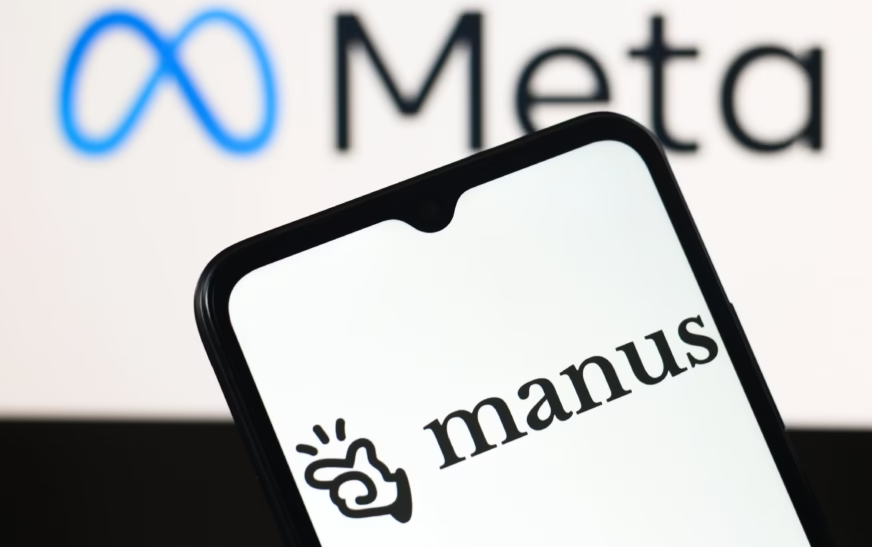
If you logged into Meta Ads Manager any time after February 2026 and noticed a new pop up offering an AI work partner, you were not imagining it. Meta has quietly begun rolling out Manus AI, the autonomous agent technology it acquired for over $2 billion at the end of 2025, directly into the advertising platform used by more than 4 million advertisers worldwide, including a fast growing share of African brands and agencies.
This is not another chatbot. Manus is a general purpose autonomous AI agent designed to break complex goals into sub tasks, select the right tools, execute each step, and deliver completed results with minimal human oversight. Inside Ads Manager, it currently handles report generation, audience research, performance pattern analysis, and recurring analytical tasks.
Why this matters now
As Marketing Brew detailed in early April, Meta has been moving aggressively toward AI driven automation across its ad stack for over a year. The Manus rollout sits alongside Meta’s Andromeda ad retrieval system, which has already overhauled how ads are matched to users, and the expanding Advantage+ AI tool suite covering creative, targeting, and budget optimisation.
For context, the global AI agents market is projected to grow from $7.84 billion in 2025 to $52.62 billion by 2030, according to MarketsandMarkets data referenced by AI2Work. Meta is reportedly spending between $115 billion and $135 billion on AI infrastructure in 2026 alone, nearly double its 2025 commitment, and advertising is the most direct path to monetising that spend.
What changes for African advertisers
For Nigerian, Kenyan, South African, and Ghanaian marketers running Meta campaigns, the practical implications are immediate.
Reporting and analysis become faster but less differentiated. Junior analysts spending hours pulling weekly performance reports will find Manus doing the same work in minutes. The competitive edge shifts to teams who can ask better questions and interpret outputs with local market context.
The black box problem deepens. Meta’s automation already removes targeting, budgeting, and creative decisions from advertiser hands. Manus extends that further. As covered in our recent feature on Africa’s two speed digital economy, African advertisers in particular need to weigh how much automation they can responsibly hand over when their markets behave differently from the global default.
Smaller agencies gain leverage. A two person Lagos or Nairobi agency can now run analytics workflows that previously required a dedicated insights team. The cost ceiling for sophisticated campaign management is dropping. The skill ceiling, however, is rising fast.
The competitive backdrop
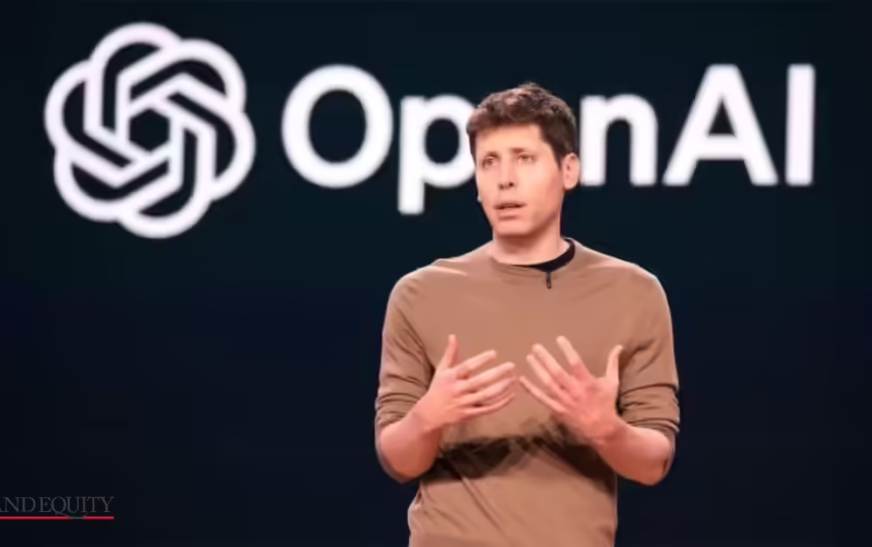
Meta is not alone. As MarketingProfs reported in its April AI update, OpenAI is projecting $100 billion in annual ad revenue by 2030 as it builds advertising into ChatGPT, Google has launched its Universal Commerce Protocol enabling AI agents to handle full shopping journeys, and Anthropic, Nvidia, Perplexity, and Snowflake are all racing to ship enterprise grade autonomous agents.
For African marketing leaders, the strategic question is no longer whether AI agents will sit inside the ad stack. They already do. The question is which teams have the local market judgement, data discipline, and creative direction to use them well, and which will simply hand over their campaigns and hope for the best.