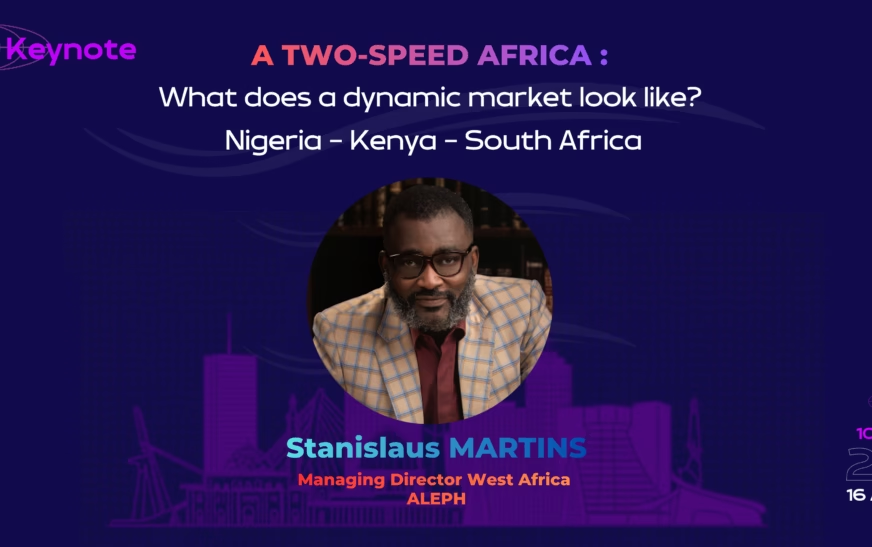

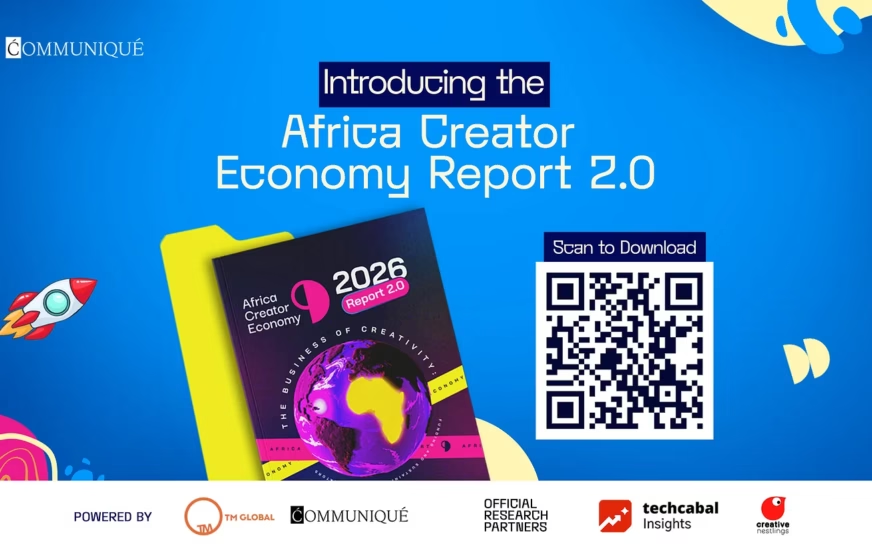
Africa’s creator economy has crossed an important line. According to the Africa Creator Economy Report 2.0, published by Communiqué and TM Global at the Africa Creators Summit in Lagos earlier this year, the sector is now valued at $3.08 billion, with a projected climb to $17.84 billion by 2030. The headline number sounds like good news. The earnings data tells a much harder story.
The same report found that 60 percent of African creators earn less than $100 per month from their digital work, and 54 percent earn less than $62 monthly. These are the people producing Afrobeats videos that Spotify pushes onto global charts, lifestyle content that Parisian trend agencies quietly screenshot, and TikTok formats that get replicated worldwide without a single credit line. The audience scale is real. The income, in most cases, is not.
Why the gap exists
The structural problem sits inside the monetisation rails themselves. As detailed in a recent Business and Financial Times feature, most global creator monetisation systems were designed for markets with stable banking, high card penetration, and predictable currency. None of those assumptions hold cleanly in Nigeria, Ghana, Kenya, or large parts of Francophone Africa, where mobile money is the dominant payment rail and currency volatility eats into delayed payouts.
There is also an audience size problem. The report shows that 57 percent of African creators have fewer than 10,000 followers, while only 7.5 percent have more than 500,000 followers, the threshold where serious brand budgets start to flow. Most of the continent’s creators sit in the long tail with little leverage, and the platforms have not yet built monetisation tools that work meaningfully at that scale.
What is changing
Income mix is starting to shift. Brand sponsorships now account for 28 percent of creator income, followed by direct sales of digital products and services at 25 percent, and physical merchandise at 14 percent. Pure ad revenue, the model many creators initially chased, contributes only around 6 percent. As Techpoint Africa noted in its analysis, this points to a future where the most successful African creators will look less like influencers and more like founders, building products, communities, and direct to fan businesses on top of their content.
The other shift is platform behaviour. Aleph, Meta, TikTok, and YouTube have all begun adapting payout structures and creator funds to reflect African market realities. Business Elites Africa reports that platforms are slowly integrating mobile money options and shorter settlement cycles, though progress is uneven.
What this means for African marketers
For brands and agencies on the continent, the takeaway is simple. The creator economy is no longer a side bet. It is a $3 billion line item that will quintuple within five years if current trajectories hold. But buying creator media in Africa requires a different lens than buying it in New York or London. The talent pool is wider, cheaper, and more culturally specific. The infrastructure is weaker. The opportunity for brands willing to build long term creator partnerships, instead of one off campaigns, is enormous.
The creators are already here. The question is whether the rest of the ecosystem catches up before another generation of African talent goes global without going wealthy.