
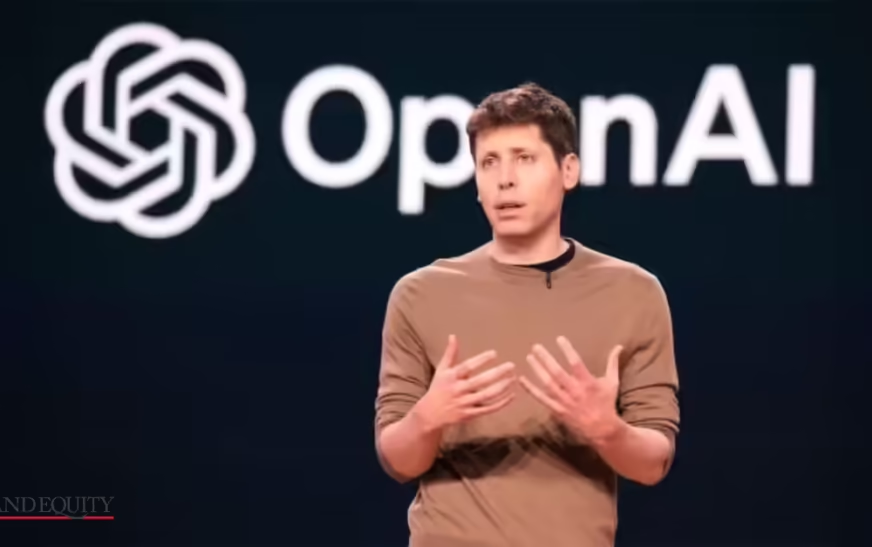
OpenAI, the company behind ChatGPT, is publicly projecting $2.5 billion in advertising revenue in 2026 scaling to $100 billion annually by 2030. According to figures cited in MarketingProfs’s April AI update, the company’s early advertising pilot generated $100 million in annualised revenue within two months. For African marketers still treating AI as an internal productivity tool, that is the wake up call. Conversational AI is becoming a media channel, and the buying interfaces are being built right now.
Why conversational AI is so valuable to advertisers
Traditional digital advertising relies on inferring user intent from behaviour. Search ads come closer because users type what they want. Conversational AI advertising goes further still. When a user asks ChatGPT for the best running shoes for flat feet under fifty thousand naira, that is not an inferred intent. It is an explicitly stated, fully contextualised commercial intent expressed in natural language. For brands, this is the cleanest signal of purchase readiness ever offered by a digital platform.
The risk, as OpenAI itself acknowledges, is trust erosion. AI assistants work because users believe the answers are objective. Inserting paid placements clumsily breaks that trust quickly. OpenAI is reportedly designing its ad layer with explicit transparency, separation from core responses, and clear disclosure, though the long term execution will determine whether users accept it.
What this looks like across the AI advertising race
OpenAI is not moving alone. Meta’s Manus AI rollout inside Ads Manager, covered in our recent piece on the African advertising implications, is one move. Google’s Universal Commerce Protocol, which lets AI agents handle the full shopping journey from research to checkout, is another. Perplexity, Anthropic, Nvidia, and Snowflake are all building autonomous agent capabilities with commercial implications.
The global MarTech market itself is now valued at approximately $669 billion in 2026 and growing at over 19 percent annually, with autonomous marketing agents named as a defining trend by Precedence Research. Africa’s share of that pie is small in absolute terms but growing fast, with Nigerian, Kenyan, and South African brands among the early adopters of generative tools in advertising.
What African brands and agencies should do now
1. Audit your AI search visibility. Tools like AEO (Answer Engine Optimisation) are already being adopted by sophisticated South African agencies. If your brand does not appear in ChatGPT, Perplexity, or Gemini responses to high intent commercial queries, you are already losing market share you cannot see in your analytics.
2. Build first party data infrastructure. Conversational AI advertising will reward brands with rich, consented customer data that can be matched against AI surfaces. Cookie based retargeting is dying. Owned data is the new currency, a point covered well in the African Marketing Confederation’s 2026 trends outlook.
3. Negotiate AI usage rights into creator deals. As more African creator content gets pulled into AI training and AI surfaced recommendations, brands and creators alike should formalise how that content can be used by AI platforms commercially.
4. Prepare for AI agent commerce. When a customer’s AI agent shops on their behalf, the agent does not respond to TikTok ads or display banners. It responds to clean product data, structured pricing, and authoritative review signals. African ecommerce brands that get this right early will compound the advantage.
The $100 billion number is not a finished prediction. It is a strategic signal. The advertising industry is being rebuilt around AI assistants, and Africa has roughly two years to build the muscle memory for it before global brands and platforms decide how the local market gets served.